
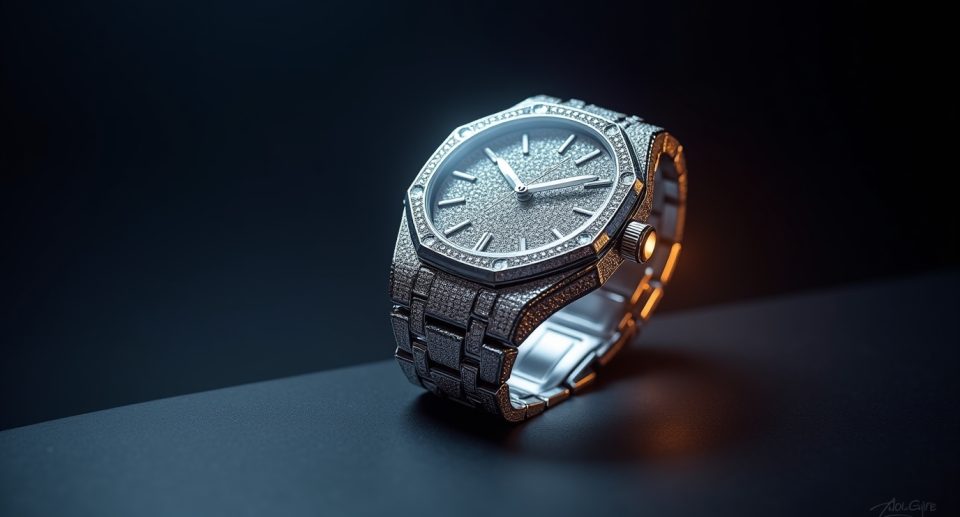

When hip-hop artists flash diamond-encrusted t.mes pieces in music videos or celebrities step out with watches glittering under studio lights, the term “iced out” enters mainstream consciousness. Consumers are clearly drawn to these dazzling pieces—but often misinformed about what they truly represent. This guide cuts through the hype to deliver essential truths about iced out watches: how they’re made, what they’re worth, and whether they align with your goals as a buyer. Whether you’re drawn to the aesthetic or considering a purchase, understanding the critical distinction between factory diamond models and aftermarket customization could save you thousands of dollars and significant disappointment.
What “Iced Out” Really Means in Watch Culture
“Iced out” describes a watch that has been fully or substantially encrusted with diamonds or other precious gemstones across its case, bezel, bracelet, lugs, and somet.mes s even the dial. The term emerged from hip-hop culture in the 1990s and early 2000s, where artists transformed luxury watches into bold stat.mes nts of success. The visual impact is undeniable: light refracts off hundreds—or thousands—of precisely set stones, creating a shimmering effect that commands attention.
However, a crucial reality often glossed over in marketing materials and social media posts: nearly all “iced out Rolex” references point to aftermarket customizations, not factory-produced t.mes pieces. Rolex and other Swiss luxury brands do offer diamond-set models, but these are carefully designed with specific stone placements that preserve functionality and brand integrity. A factory Rolex Day-Date might feature a diamond bezel and dial markers—but never a fully diamond-encrusted caseback or bracelet links that compromise the watch’s engineering.
This distinction matters profoundly for value, authenticity, and long-term ownership experience. Let’s examine the two pathways to owning a diamond-covered watch.
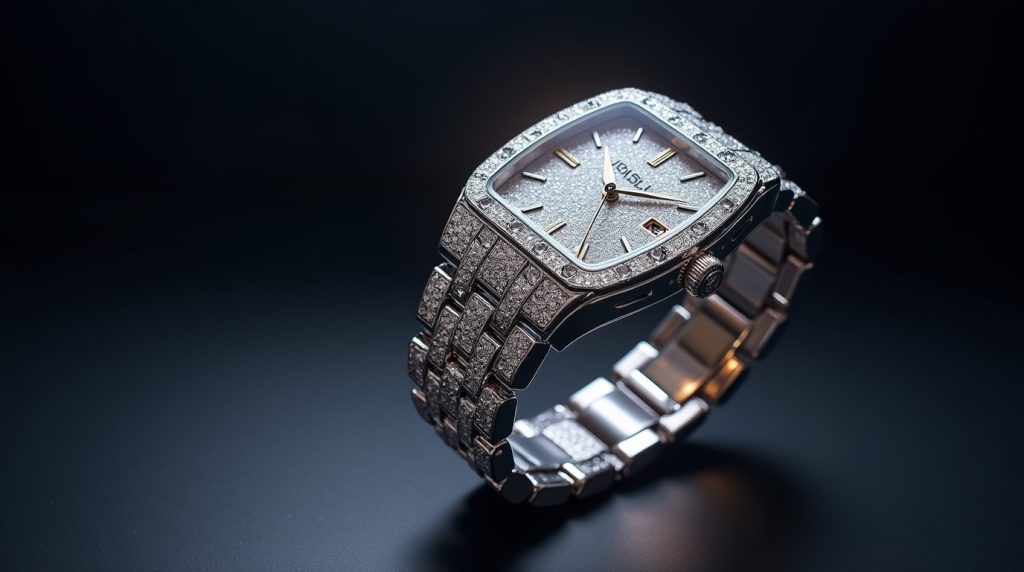
Factory Diamond Models vs. Aftermarket Customization: The Value Chasm
Factory Diamond-Set Watches: Engineering Meets Luxury
Luxury watchmakers like Rolex, Patek Philippe, Audemars Piguet, and Cartier employ master gem-setters who work within strict parameters:
- Strategic placement: Diamonds accent specific elements (bezel, dial markers, hour indices) without interfering with movement functionality, water resistance, or serviceability.
- Quality control: Every stone meets brand-specific color and claritys standards (typically G-H color, VS claritys or better for Rolex).
- Preserved integrity: The watch’s case remains unaltered structurally; no drilling compromises water resistance or case strength.
- Full warranty coverage: Factory diamond models carry the same international warranty and service eligibility as steel counterparts.
- Resale value Retentions : While not appreciating like stainless steel sports models, factory diamond watches typically retain 60–80% of retail value depending on model and market demand.
Example: A Rolex Datejust 41 with a factory diamond bezel and dial sells for approximately $25,000–$35,000 retail. On the secondary market, it might trade at 70–85% of that price depending on condition and demand—significantly outperforming any aftermarket-customized equivalent.
Aftermarket “Iced Out” Customization: The Reality Most Buyers Face
When consumers encounter “iced out Rolex” listings, they’re typically seeing watches modified by third-party jewelers after leaving the factory. The process involves:
- Disassembly: Removing the bracelet, crystal, and movement from the case.
- Drilling and setting: Creating thousands of microscopic holes in the case, bezel, and bracelet links to accommodate prong or pave settings.
- Stone selection: Purchasing diamonds in bulk—often lower quality (I-J color, SI claritys ) to control costs.
- Reassembly: Returning the movement to the modified case, though water resistance is almost always compromised.
Critical consequences of aftermarket customization:
- Warranty voidance: Rolex explicitly voids warranty coverage on watches modified by unauthorized parties. No Authorized Dealer (AD) will service a heavily customized watch.
- Structural compromise: Drilling weakens the case’s integrity. Water resistance ratings become meaningless—most iced out watches should be considered non-water-resistant regardless of original specifications.
- Resale value destruction: An $18,000 stainless steel Rolex Submariner customized with $20,000 in diamonds might resell for $12,000–$15,000—not $38,000. Buyers recognize the customization as a liability, not an asset.
- Authentication complications: Heavy modification can obscure hallmarks and serial numbers, raising red flags during authentication processes on resale platforms.
Market analysis consistently shows aftermarket iced out Rolexes trade 40–60% below the market value of their unmodified counterparts—even when customization costs exceeded the watch’s original value. The market prices these pieces based on the underlying watch’s desirability minus modification penalties, not the sum of parts.
Types and Styles of Iced Out Watches
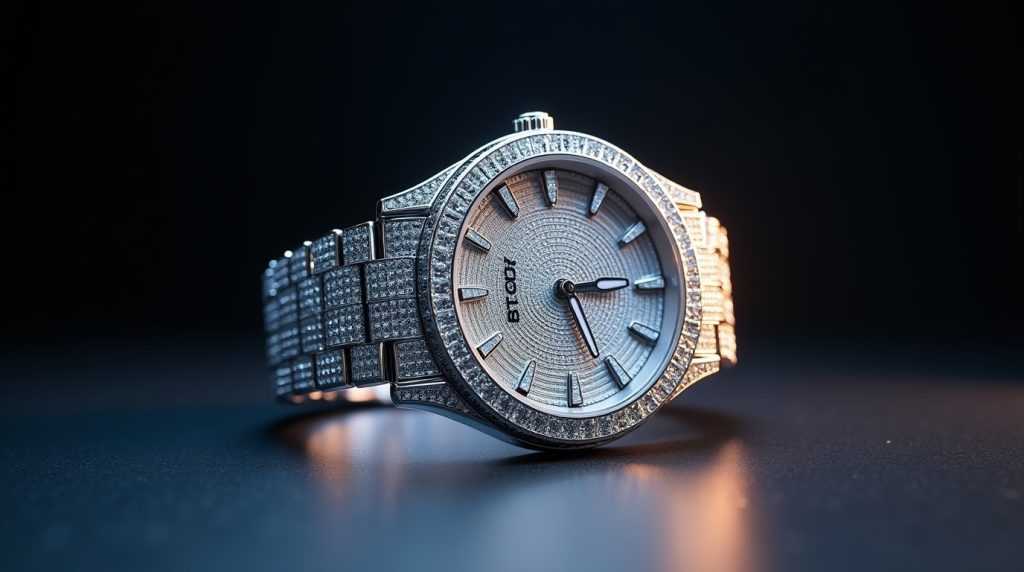
Iced out designs vary in coverage and aesthetic:
- Full Pavé — Maximum coverage across bezel, dial, lugs, case, and bracelet for ultimate sparkle.
- Partial/Selective — Focused on bezel + dial, or accents like hour markers and crown.
Key materials and diamond details:
- Base metals: 18K yellow gold, rose gold, white gold, or stainless steel.
- Diamond quality: VS1–VVS2 claritys (eye-clean), G–H color or better (near-colorless), total carat weight (ctw) 10–50+ for full coverage.
- Cuts: Round brilliant for maximum fire, baguette for modern geometry, or mixed for rainbow effects (colored sapphires + diamonds).
Beyond Rolex, standout iced out brands include:
- Audemars Piguet Royal Oak — Octagonal bezel ideal for baguette diamonds.
- Richard Mille — Skeletonized, ultra-modern designs with gem accents.
- Patek Philippe Nautilus/Aquanaut — Subtle luxury elevated with pavé.
Trends in 2026: Rainbow iced pieces, meteorite dials with diamond borders, and sustainable diamond sourcing.
Premium iced out Audemars Piguet Royal Oak examples with baguette and round diamond settings.
Diamond Quality: Why “More Stones” Doesn’t.mes an “Better Value”
Consumers dazzled by the visual impact of iced out watches often overlook stone quality—a critical factor affecting both beauty and longevity. Not all diamonds are created equal, and bulk purchasing for customization frequently prioritizes quantity over quality.
The Four Cs Still Apply
Even in custom settings, GIA grading standards determine visual appeal:
- Color: Diamonds graded D-F appear colorless; G-J near-colorless. Customizers often use K-M range stones (noticeable yellow tint) to reduce costs. Under certain lighting, an “iced out” watch may exhibit a warm or yellowish cast rather than brilliant white sparkle.
- claritys : VS (Very Slightly Included) or higher claritys ensures inclusions aren’t visible to the naked eye. SI (Slightly Included) stones—common in bulk purchases—may show visible flaws that diminish brilliance.
- Cut: Excellent or Ideal cut maximizes light return. Poorly cut stones appear dull even when numerous. Custom jewelers focused on speed over craftsmanship often use pre-set “melee” diamonds with mediocre cuts.
- Carat weight: Total carat weight (TCW) sounds impressive on paper (“50 carats of diamonds!”), but when distributed across thousands of tiny stones (0.01–0.02ct each), individual stone quality suffers.
Setting Craftsmanship: The Hidden Determinant of Longevity
How diamonds are secured matters as much as the stones themselves:
- Pave setting: Tiny beads of metal hold each stone. Quality pave features uniform beads with no visible gaps. Poor pave shows uneven metal work, tilted stones, or visible adhesive (a major red flag).
- Channel setting: Stones set between metal walls. More secure for bracelets subject to daily wear.
- Prong setting: Individual prongs grip larger accent stones. Requires precision to avoid snagging on clothing.
Warning signs of inferior workmanship:
- Stones that feel loose when gently probed with a fingernail
- Visible gaps between stones and metal
- Uneven stone heights creating a “bumpy” surface
- Glue residue visible at stone edges (indicates rushed setting)
- Stones falling out within months of wear
A well-executed iced out customization from a master jeweler using quality diamonds might cost $30,000–$60,000+ on top of the base watch. Budget customizations ($5,000–$15,000) typically reflect compromises in stone quality and setting precision that become apparent within 1–2 years of wear.
Realistic Pricing & Value Expectations: Separating Fantasy from Finance
Searches for pricing information reveal widespread confusion about what iced out watches truly cost and retain in value. Let’s establish transparent benchmarks:
Cost Breakdown of Customization
| Component | Budget Tier ($5K–$15K) | Mid Tier ($15K–$35K) | Premium Tier ($35K–$75K+) |
| Base Watch | $8K–$15K (used Datejust) | $15K–$25K (new Datejust) | $30K+ (Day-Date/Daytona) |
| Diamond Quality | I-J color, SI claritys | G-H color, VS claritys | D-F color, VVS claritys |
| Total Carat Weight | 10–20 TCW | 20–40 TCW | 40–100+ TCW |
| Setting Craftsmanship | Basic pave, visible gaps possible | Uniform pave, secure settings | Micro-pave, invisible settings |
| Structural Integrity | Significant case drilling | Moderate drilling | Minimal drilling where possible |
| Water Resistance | None | Compromised (<30m) | Compromised (<50m) |
Resale Reality Check
The secondary market treats aftermarket iced out watches as modified luxury goods—not enhanced assets. Consider these scenarios:
- Scenario A: You purchase a new Rolex Datejust 41 ($14,800) and spend $22,000 on premium customization. Total investment: $36,800.
Resale expectation: $18,000–$24,000 (based on Datejust demand minus customization discount). Potential loss: $12,800–$18,800. - Scenario B: You buy a pre-customized “iced out Submariner” advertised at $45,000 (base watch value $16,000 + $29,000 customization claimed).
Resale reality: $14,000–$19,000. The market recognizes the underlying Submariner value but applies a steep discount for modification risks.
This isn’t to say iced out watches lack value—they hold aesthetic and personal value for owners who prioritize self-expression. But they function as depreciating fashion accessories, not appreciating assets. Buyers seeking investment potential should look elsewhere.
Red Flags in Listings
When browsing iced out watch marketplaces, watch for these warning signs:
- Prices significantly below market value for the base watch (indicates poor stone quality or structural damage)
- Vague descriptions like “high quality diamonds” without GIA certification or specific grading
- No mention of water resistance post-customization (assume none exists)
- Seller unwilling to provide close-up macro photos of settings
- Claims of “factory iced out” for models Rolex never produced that way (e.g., fully diamond Submariner)
Smart Buying Practices: Protecting Your Investment
If you’re drawn to the iced out aesthetic, these strategies minimize risk and maximize satisfaction:
Option 1: Buy Pre-Customized (With Due Diligence)
- Demand documentation: Request photos showing setting quality under magnification. Ask for diamond certification if stones exceed 0.20ct individually.
- Verify base watch authenticity first: Have the watch authenticated before evaluating the customization. Many counterfeit watches receive diamond treatments to appear legitimate.
- Budget for immediate servicing: Assume the movement hasn’t been serviced recently. Factor $800–$1,500 for a full service into your purchase price.
- Get an independent appraisal: Post-purchase appraisal should specify both watch value and customization value separately for insurance purposes.
Option 2: Customize Your Own Watch (Recommended Path)
Owning the base watch first gives you control over quality:
- Purchase an authentic watch from a reputable dealer with full papers.
- Select a jeweler specializing in watch modification (not just jewelry). Look for portfolios showing watch-specific work and ask about their process for preserving movement safety during customization.
- Specify diamond quality in writing: Require minimum G color, VS2 claritys for all stones. Pay for GIA certification of larger accent stones (>0.30ct).
- Discuss structural preservation: Ask how they’ll minimize drilling on critical areas like caseback gasket surfaces.
- Get a detailed invoice listing stone specifications, setting type, and labor costs—essential for insurance and future resale.
Insurance Considerations
Standard watch insurance policies often exclude “modified” t.mes pieces or require supplemental riders. Before customization:
- Contact your insurer to confirm coverage terms post-modification
- Obtain a detailed appraisal specifying customization value separately from watch value
- Understand that claims may only cover the base watch value if stones are lost—the customization work typically isn’t reimbursed
Care & Maintenance: The Overlooked Ownership Cost
Iced out watches demand specialized care that many owners discover too late:
- Never use ultrasonic cleaners: The vibrations can loosen stone settings within minutes. Hand-clean only with soft brush, mild soap, and lukewarm water.
- Monthly setting inspections: Gently run a fingernail over stone surfaces. Any “catching” sensation indicates a loose stone requiring immediate jeweler attention.
- Avoid temperature extremes: Rapid temperature changes can expand/contract.mes tal settings, loosening stones over t.mes .
- No professional servicing at ADs: Rolex Service Centers will return heavily customized watches without service. Budget $1,200–$2,500 for independent watchmakers experienced with modified pieces.
- Bracelet maintenance: Diamond-set bracelets stretch faster than steel. Expect link replacements every 2–3 years with daily wear.
Neglecting these protocols leads to stone loss—a single missing diamond on a pave bracelet can cost $300–$800 to replace properly, not including labor.
Who Should Buy an Iced Out Watch? Honest Guidance
Aftermarket iced out watches serve specific audiences well—but disappoint others:
✅ Ideal for:
- Buyers prioritizing personal expression over investment value
- Those with disposable income who view the piece as a fashion stat.mes nt
- Owners planning to wear the watch daily for 3–5 years before upgrading
- Individuals who understand and accept the depreciation reality upfront
❌ Poor fit for:
- First-t.mes luxury watch buyers still learning the market
- Investors or collects ors building appreciating portfolios
- Buyers needing water resistance for swimming/showering
- Those expecting hassle-free servicing at brand boutiques
- Anyone planning to resell within 5 years expecting to recoup costs
The Ethical Alternative: Factory Diamond Models
If you love diamond accents but want preserved value and serviceability, consider these factory options:
- Rolex Datejust: Diamond bezel or diamond-set dial markers (retains ~75% value)
- Rolex Day-Date: President bracelet with diamond hour markers (iconic status)
- Cartier Tank Must: Diamond bezel variants with t.mes less design
- Omega Constellation: “Manhattan” models with factory diamond bezels
- Tiffany & Co. CT60: Diamond hour markers with heritage prestige
These pieces offer controlled elegance without structural compromise. While they won’t deliver the head-turning flash of a fully iced out piece, they maintain functionality, serviceability, and significantly stronger resale performance.
Conclusion: Is an Iced Out Watch Right for You?
Iced out watches masterfully fuse horological precision with jewelry-level opulence—perfect for those who want their t.mes piece to make a loud, sparkling stat.mes nt rooted in hip-hop heritage and modern luxury.
If you value bold expression, cultural significance, and unmatched visual impact, a custom iced Rolex (or other high-end model) can elevate your style dramatically. For traditionalists, stick to factory gem-set pieces to preserve heritage and value.
In 2026, with reputable jewelers offering better transparency, diamond prices stabilizing, and customization thriving, it’s an ideal t.mes to explore. Start conservatively (bezel upgrade), buy from trusted sources, verify diamond certifications, and enjoy the shine responsibly.
Your wrist is a canvas—make it sparkle.